Should You Pay Off Debt or Invest? What to Do With a Lump Sum
I recently came across a question that perfectly captures one of the most common financial dilemmas people face: what to do when you receive a lump sum of money (sometimes called a financial windfall).
"My spouse and I are about to receive a $100,000 windfall. We have about $20,000 in consumer debt (credit cards, personal loan, car loan) that we'll pay off immediately. But we disagree on what to do with a $55,000 home equity loan at 7% interest. I want to pay it off. My spouse thinks that money could be better used for investments or real estate—things with more upside. If we pay off all the debt, we'll only have $25,000 left, which doesn't feel like the life-changing windfall we were hoping for. What should we do?"
This question resonates because it's not just about math. It's about feeling rich versus being wealthy, guaranteed returns versus potential gains, and most importantly, about understanding your own patterns and what will actually serve your goals.
As a financial coach, I see this question a lot, so let me walk you through how to think about this decision.
Should You Pay Off Debt or Invest? (Quick Answer)
If your debt is around 7% or higher, paying it off is often a strong, low-risk option because it guarantees that return
If your debt is below ~5%, investing may lead to higher long-term returns
If you’re not confident you’ll actually invest the money (or if it’s more likely to get spent), paying off debt is usually the safer choice
The right decision isn’t just about the numbers—it depends on your goals, habits, and what you’ll realistically follow through on.
If you want to understand why this is the case—and how to decide based on your situation—let’s break it down.
Evaluating the Numbers
Most people jump straight to the numbers when evaluating the choice between paying off debt and investing. And the numbers are certainly a major consideration. The easiest way to compare is to look at the interest rates on your debt versus the expected return on your investments.
Interest Rates on Debt
Calculating the interest rates on your debt is fairly straightforward: it’s just the interest rate they are charging you. You can easily find this information on your statement (though credit card companies like to bury this information, so you might have to scroll down a ways to find it).
Think of your debt interest rates this way: if you pay off the debt now, you won’t have to pay those interest rates and you’re coming out ahead. This is a guaranteed rate of return because you know exactly how much interest you’ll save (or pay).
Learn more about paying off debt.
Investment Returns
Calculating the interest rate or rate of return on investments is trickier because you don’t always know what will happen. If you have a high yield savings account, CD, or other fixed return investment, it’s easy—they tell you how much you’re earning.
But many investments, including stocks, ETFs, and mutual funds do not have a guaranteed return. They fluctuate based on market conditions. It’s possible for them to return a lot in some years and lose value in others.
That’s why finance experts generally look at the type of investment and long-term trends. A general rule of thumb is that investments tend to go up over time and you could maybe expect an 8-10% return if you have a solid investment strategy.
But this is not guaranteed and investing always involves risk and uncertainty. That doesn’t mean you shouldn’t do it—it just means that you need to be aware and work with a licensed investment advisor or Certified Financial Planner to develop an investment plan that’s right for you and your situation.
Comparing the Numbers
So if you’re comparing the numbers, you could look at the interest rate you’re paying on your debt and compare it to the interest rate or rate of return you could get on investing.
Sometimes looking at the numbers provides a clear answer. For example, if your choice is between investing (assuming a 8-10% return) and paying off your mortgage at 2.5%, investing could be a clear choice from a numbers perspective.
Similarly, if your choice is between investing and paying off a credit card with a 30% interest rate, paying off the credit card will clearly help you come out ahead.
But with a 7% interest rate on the loan, the difference isn’t as significant.
You might come out ahead if investments perform well over time. But you’re taking on more risk, continuing monthly debt payments, and need to be confident you’ll actually invest the money rather than use it for other things.
Here's what's interesting: In many cases, your long-term net worth may end up in a similar range either way—but the path to get there looks very different. The question is whether you want that wealth tied up in investments (with risk and potential upside) or in home equity (guaranteed, zero risk).
So if you’re just looking at the numbers, I encourage you to work with a financial professional who can run scenarios for you and help you develop an investment strategy that matches your risk tolerance and goals. That will give you a more realistic point of comparison (even if it’s not a guaranteed outcome).
Other Considerations
The numbers aren’t the only consideration. You’ll also want to think about things like:
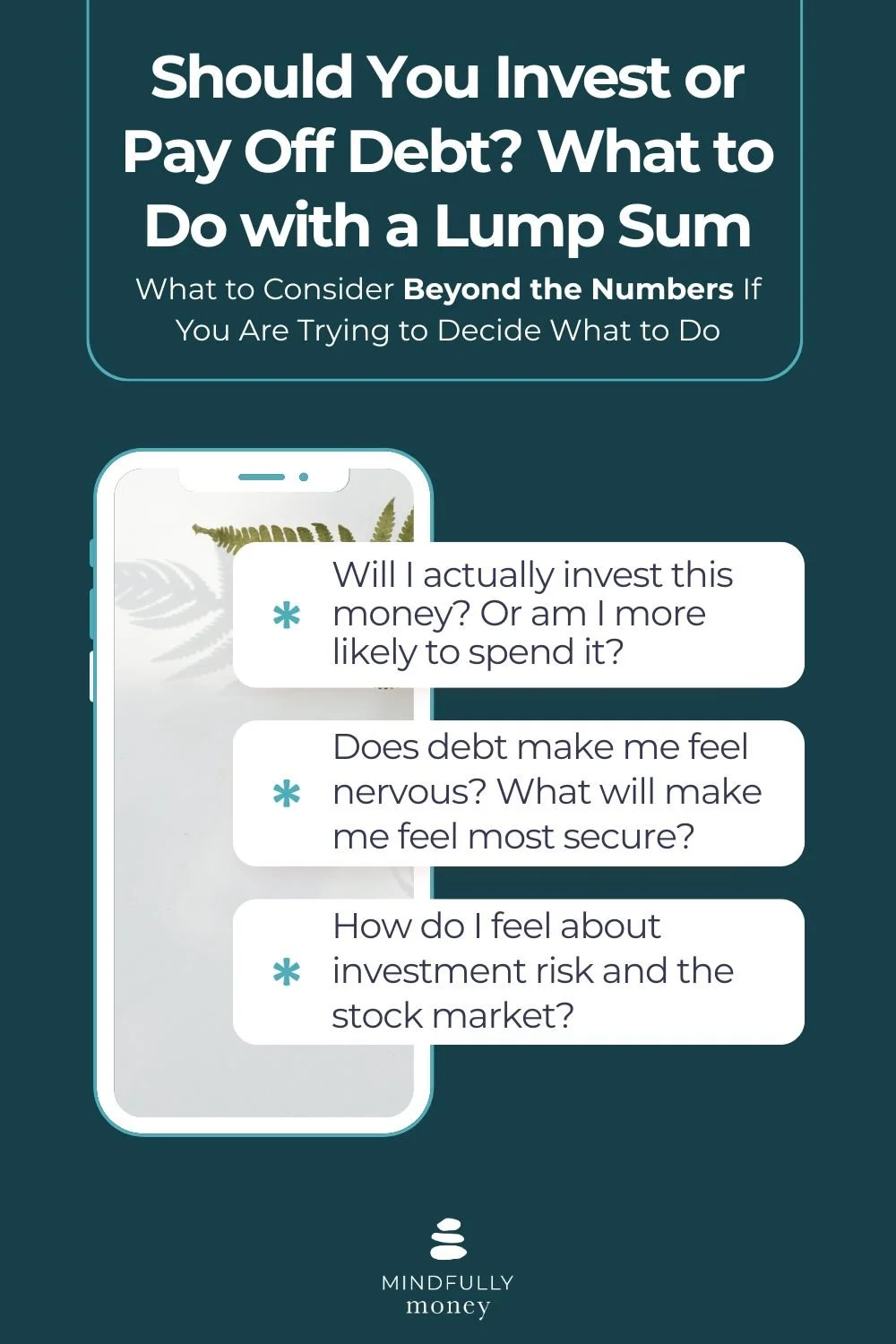
If you don’t pay off the loan, will you actually invest the money? Or are you more likely to spend it? (Be honest with yourself—if you’re not certain that you’ll invest the money, it’s better to pay off that debt and guarantee the return.)
How do you feel about your debt? Does it keep you up at night or does it generally not bother you?
Imagine yourself in 20 years. How would you feel about still having debt? Will you still want to have that payment if you’re retired?
What’s your risk tolerance? If you invest that money today and the market crashes, how would you feel?
What are your long-term goals and how does each option support them?
When to Pay Off Debt and When to Invest
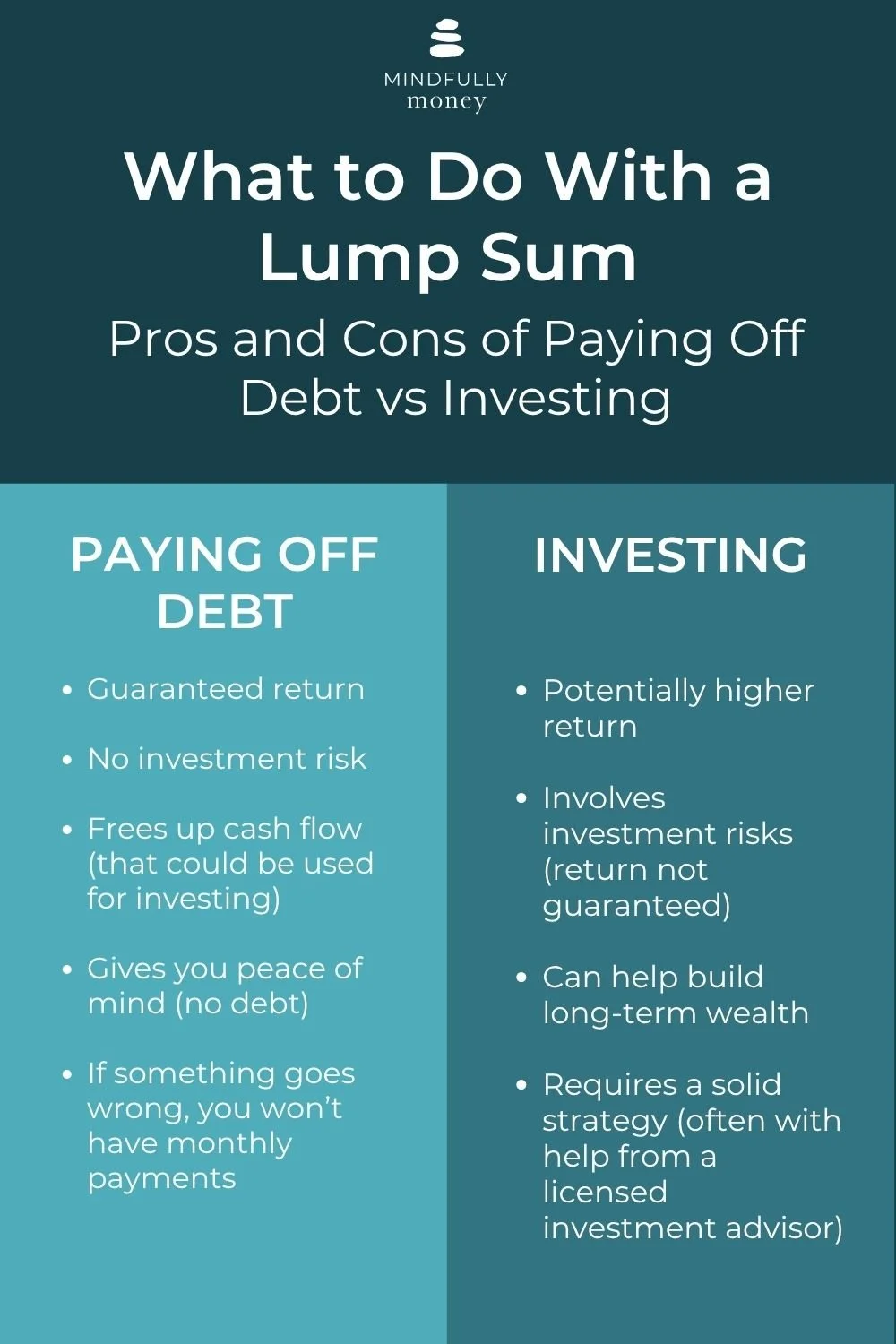
Although the best decision is the one that makes the most sense for you, here are a few general guidelines on when each one makes more sense.
*Note: There are many things we don’t know about this couple’s financial situation that could affect the decision. For example, if they don’t have an emergency fund or aren’t saving for retirement, those would be better places to start. The following considerations assume that they’ve taken care of those things and are truly deciding between paying off debt and investing (beyond retirement).
When Paying Off Debt Makes More Sense
Paying off debt is usually the better choice if:
Your interest rate is around 7% or higher
You’ve had a pattern of spending vs. saving
You still have other consumer debt
You want more breathing room in your monthly budget
Peace of mind matters more than optimizing returns
You’re not 100% confident you’ll invest the money
You’re not confident with money or you don’t trust yourself to follow through
When Investing Might Make More Sense
Investing can make sense if:
Your debt is below ~5%
You already invest consistently (retirement + brokerage accounts)
You have a strong financial foundation (emergency fund, no consumer debt)
The debt is strategic (not lifestyle-driven)
You have a clear, specific investment plan
Doing Both
You don’t have to put all of your money in one place. You could do a combination of things, paying off some of the debt, investing some of it, and spending some on whatever you want.
What I’d Recommend
I don’t know the couple in question and I’d spend time getting to know more about them and their financial situation before I recommended anything to them.
But if it was me, I would likely pay off the debt. Then I’d take what I had been paying toward those debts and invest it. (I’d probably also use some of it for a trip or something else I’d been wanting to buy.)
This would enable me to find a balance between increasing my financial security (by ensuring I keep my home if something happens and I can’t make the payments), investing (growing my wealth), and enjoying life now.
If They Were My Clients
Again, I don’t know this couple or their situation, but there are a few things that I’d want to explore if I were their financial coach because I’ve seen things like this before.
Are they still accruing debt?
It’s common for people in debt to pay off all of their debt with a windfall only to end up back in it again because their expenses are still higher than their income. It’s why so many people get stuck in the cycle of debt.
If that’s the case, I would want to work with this couple first on managing their money so that they are no longer accruing more debt and making sure they have an emergency fund and other savings to pay for surprises and things they want to do in the future.
Learn More:
Build awareness of spending patterns with my free Spending Reset Guide
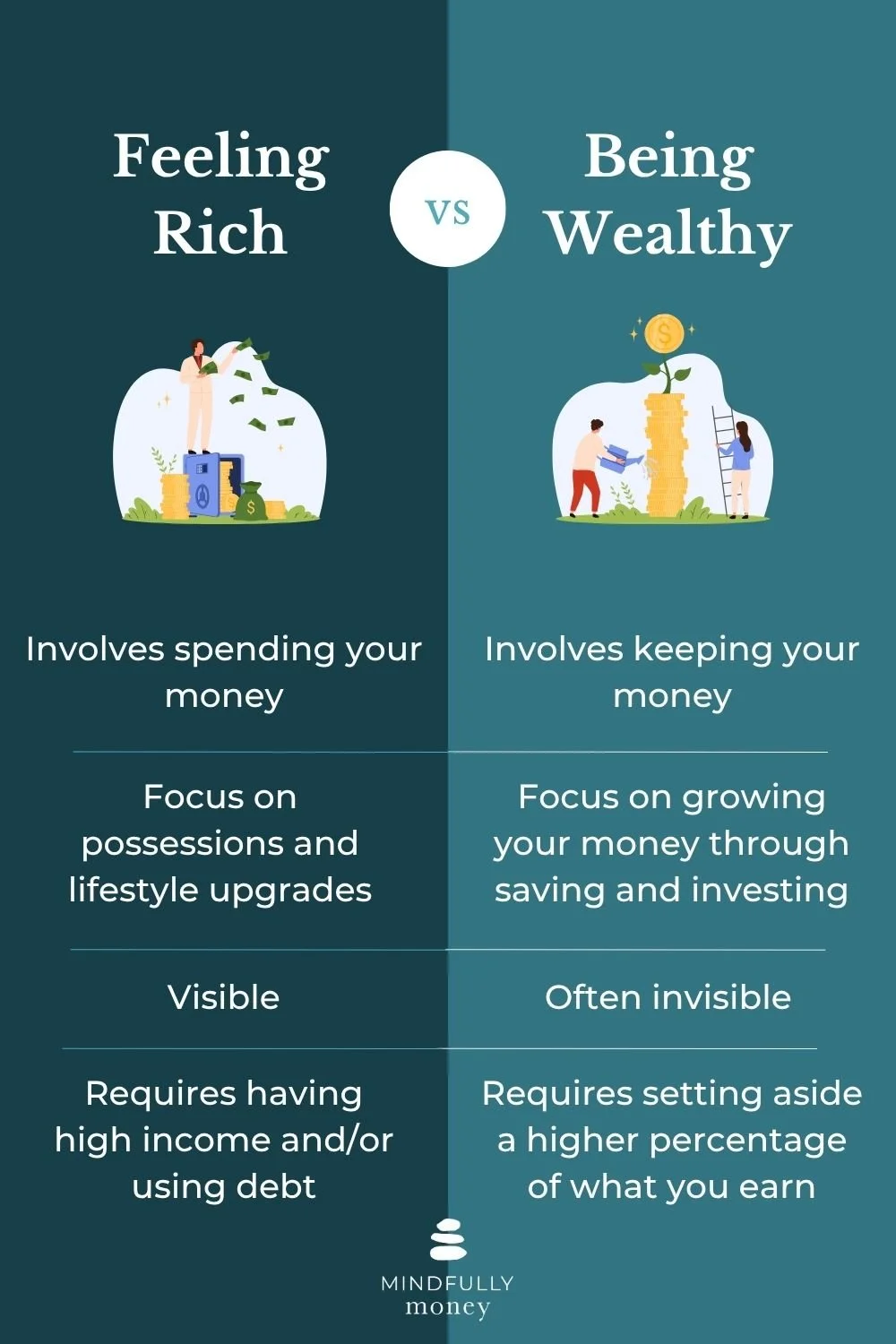
“Feeling Rich” vs Being Wealthy
This couple mentioned wanting to "feel rich" with the windfall. This feeling is completely understandable and valid—receiving a large sum of money should feel exciting and life-changing. You've worked hard, and it's natural to want that work to translate into something tangible.
But it's worth pausing to explore what "feeling rich" actually means.
When most people imagine being rich, they picture:
A beautiful home
Nice cars
Amazing vacations
The freedom to buy what they want without worrying
These are wonderful things, and there's nothing wrong with wanting them.
But having those things is not the same as building wealth.
Wealth is what you keep and grow over time, not just what you're able to access or purchase in the moment.
Wealth isn't just a function of how much you earn (though earning more certainly helps). It's what you don't spend. It's the money growing in investments. It's the freedom that comes from not having monthly debt payments. It's the security of knowing you can handle whatever comes next.
Part of the consideration for this couple might be to explore what feeling rich means and if it is actually what they want. If having those things is a priority, that’s okay! It just means that they need to create a different plan than they would if building wealth was the priority.
The Bottom Line
There isn’t one “right” answer to this question.
There’s a version of this decision that makes sense on paper—and then there’s the version that actually works in your life.
Paying off debt gives you certainty, simplicity, and guaranteed progress.
Investing gives you potential growth—but requires consistency, patience, and a willingness to tolerate risk.
Neither one is inherently better. It depends on:
how you’ve handled money in the past
what matters most to you right now
and what you’re actually going to follow through on
If you take one thing from this, let it be this:
The best financial decision isn’t the one that looks the most optimal in theory—it’s the one you’ll actually stick with long enough to see results.
Frequently Asked Questions
Is it better to pay off debt or invest first?
If your debt is above ~7%, paying it off is often the safer option. Lower rates may favor investing.
What should I do with a financial windfall?
Start by paying off high-interest debt, building an emergency fund, then consider investing.
Can I do both?
Yes. Many people split a windfall between debt payoff, investing, and savings.
Is 7% Interest High?
A 7% interest rate is generally considered moderate to high. It’s high enough that paying it off gives you a strong guaranteed return, but close enough to long-term investment returns that either option could make sense depending on your situation.
