Should I Use My Tax Refund to Pay Off Debt? A Financial Coach's Guide
I recently came across this question in an online community, and it's one I hear/see all the time in online discussion boards and from clients:
"I'm expecting a tax refund of about $5,000 and I want to use it to pay off debt. What would be the best way to use it? I'm thinking about paying off one of the cars so I can put that monthly payment toward other debts."
First of all, if you're asking this question, you're already being very strategic about how you're thinking about this. Using your tax refund for paying off debt is a solid financial move, and you're on the right track with wanting to take one payment and put it toward other debts.
But before we dive into which debt to prioritize, let me tell you how I approach this as a financial coach—because it's probably different from the advice you've heard before.
The Short Answer
Mathematically: Pay off the debt with the highest interest rate that you can pay off completely. In most cases with a $5,000 refund, that means targeting credit card debt first (not car loans).
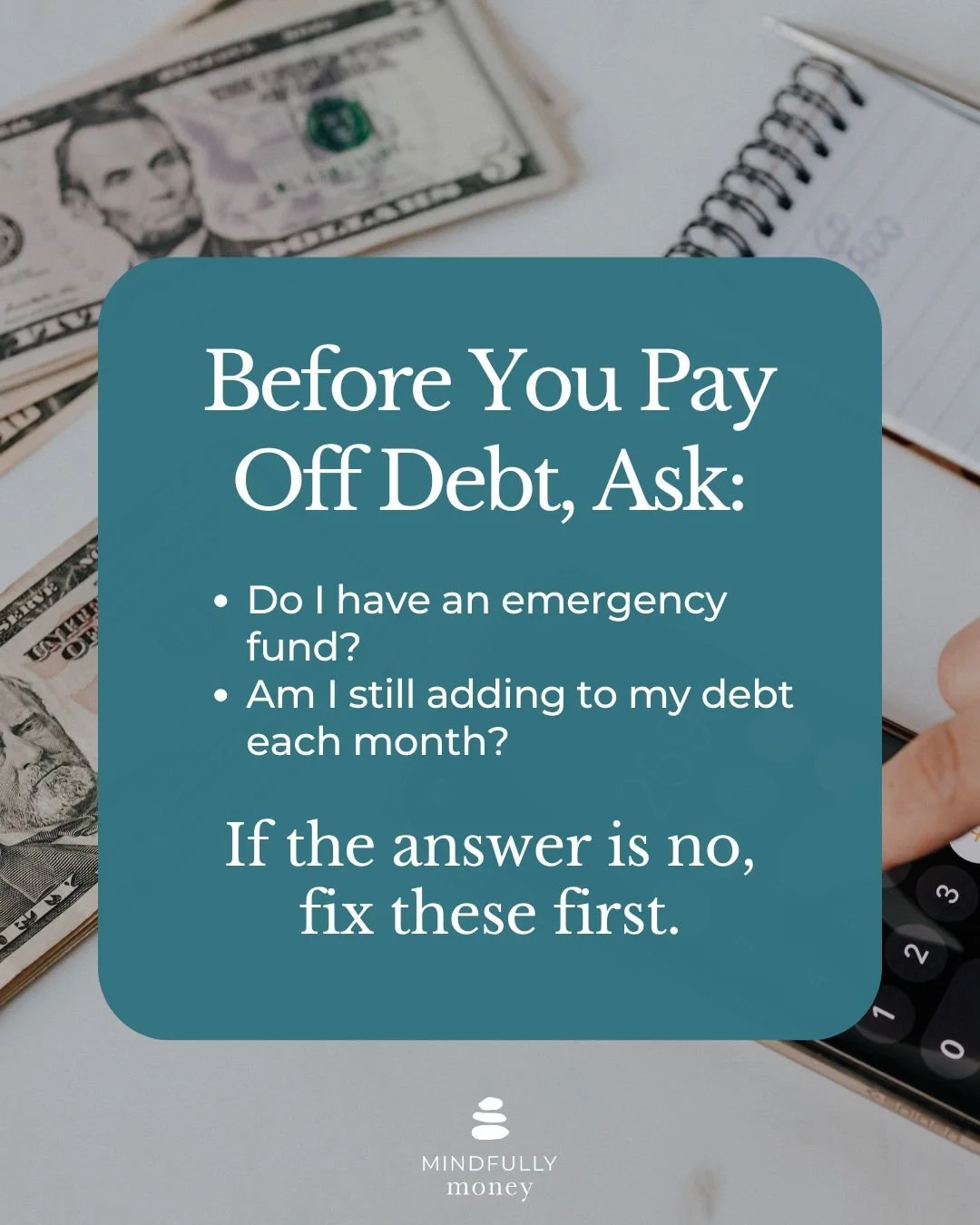
But here's what matters just as much: Do you have an emergency fund? Are you still adding to your debt each month? Do you have upcoming expenses you need to plan for?
The "right" answer depends on your complete financial picture, not just the interest rates. Let's walk through how to think about this.
Looking at the Scenario
Here's the debt situation from the question:
| Type | Balance | Interest Rate | Monthly Payment |
|---|---|---|---|
| Car Loan 1 | $4,000 | 6% | $350 |
| Car Loan 2 | $3,000 | 11% | $305 |
| Appliance Purchase | $3,000 | 0% | $61 |
| Credit Card 1 | $8,120 | 28% | $280 |
| Credit Card 2 | $2,826 | 28.31% (Promo: 0% until Jan 2027) | $98 |
| Credit Card 3 | $3,146 | 30.19% | $152 |
| Credit Card 4 | $5,614 | 28.49% (Promo: 0.9% until May 2026) | $114 |
| Total | $29,706 | $1,360 |
With a $5,000 tax refund, you have options. But which one is right?
Before You Pay Off ANY Debt: Two Questions to Consider
I'll tell you how I would prioritize this money given these debts. But first, let's look at the bigger financial picture. If you were my financial coaching client, there are a couple of things we'd want to make sure are in place before using the entire refund for debt payoff.
Question 1: Do You Have an Emergency Fund?
One of the biggest reasons why people struggle to break the cycle of debt is that they don't have any money to cover life's surprises—the emergencies, but also the sort of normal, irregular expenses that come up from time to time.
This is why paying off debt too fast can actually backfire—without an emergency cushion, one car repair or medical bill sends you right back to the credit cards, perpetuating the debt cycle.
There's always something that happens that you weren't able to anticipate, and if you don't have money on hand, you're going to have to use credit, which extends the cycle and makes it harder to get out of debt.

So step one is to give yourself some backup money. Think of it as a "keep yourself out of debt" fund.
There's no one right amount for everyone because everyone has different risks, levels of financial stability, etc. But if you don't have any money in an emergency/backup fund, I'd encourage you to use at least some of your tax refund ($1,000 minimum) for that purpose.
Question 2: Do You Have Any Upcoming Expenses You Know Are Coming?
Maybe you already planned a vacation or you know you need new tires soon. Some financial influencers will tell you to cancel your vacation and sell your car, but that may not be your preference.
In that case, I'd recommend saving some of your refund to pay for these things so that you don't have to use debt for them. Anticipating and saving for upcoming expenses is key to maintaining a debt-free lifestyle and is a good habit to get into.
And One More Thing: Are You Still Adding to Your Debt?
Before I create a debt payoff strategy with my clients, we always make sure we understand exactly what's happening with their cash flow so that new debt isn't accumulating while we're trying to pay off the old debt.
In this situation, it sounds like you're managing your debt payments and want to know how to use this extra money most effectively.
So let's assume you have an emergency fund in place and aren't adding new debt each month. That means using the entire tax refund for debt payoff is an option.
How to Decide Which Debt to Pay Off: The Math AND the Psychology
There are two ways to think about this, and neither of them is right or wrong. You need to decide which way to go to maximize your chance of success.
The Mathematical Approach: Highest Interest Rate First
From a purely mathematical perspective, paying off your highest interest rate debts first will save you the most money and help you become debt-free faster.
Looking at the debts above, Credit Card 3 at 30.19% is costing you the most. Even though it's not your largest balance, that high interest rate means you're paying about $79 in interest alone every month—money that's not reducing your balance at all.
Compare that to Car Loan 1 at 6%, which only costs you about $20 per month in interest.
If you follow the math: Pay off Credit Card 3 ($3,146) completely, then use the remaining $1,854 toward Credit Card 1, which is also charging a high interest rate.

The Psychological Approach: What Will Keep You Motivated?
Sometimes, though, the best debt to pay off first is the one that will give you the most mental and emotional relief.
If one particular debt causes you significant stress, shame, or regret—like that car you wish you'd never bought—paying it off might be the right choice for you. If eliminating that debt would help you feel better about your finances and motivate you to keep going, that's worth considering.
Another approach that works for some people is paying off smaller debts first so you can cross them off your list and get a sense of momentum. This is sometimes called the "debt snowball" method. In this particular scenario, you might start with Credit Card 2 since it has the smallest balance. However, because many of these debts are similar in size, you might not get as much psychological benefit from this approach as you would if you had one very small debt compared to the others.
My Recommendation for This Specific Situation
Here's what I'd recommend: First, ask yourself if there's one debt that's particularly stressful for you—one that, if paid off, would give you significant mental and emotional relief.
If nothing stands out emotionally, then focus on Credit Card 3 since it has the highest interest rate and you can pay it off completely with your tax refund.
Here's what I'd do with the $5,000:
1. Pay off Credit Card 3 completely ($3,146)
Eliminates your highest interest rate debt
Frees up $152/month in minimum payments
You stop paying $79/month in interest alone
2. Put the remaining $1,854 toward Credit Card 1
Reduces balance from $8,120 to $6,266
You're still paying 28% interest on this, so every dollar helps
3. Take that $152/month you were paying on Credit Card 3 and add it to your Credit Card 1 payment
New monthly payment on Credit Card 1: $432 (instead of $280)
This accelerates your payoff significantly
With this payment level, Credit Card 1 could be paid off in about 17-18 months
This is the debt snowball in action. Want to understand all your debt payoff strategy options? Check out my complete guide to the best ways to pay off credit card debt.
What happens after that:
Once Credit Card 1 is gone, take that $432 and move to the next debt. Card 4 has a promotional rate that will be going up in a few months, so that could be a good option.
This is called the debt snowball/avalanche method, and it works because you're constantly increasing your payment power as you eliminate debts.
What About Paying Off the Car First?
I know paying off the car is tempting. Eliminating that $350 monthly payment sounds like it would give you a lot of breathing room.
But here's what I've seen happen with many people: they pay off the lower-interest debt because it feels like a bigger win, while high-interest credit cards continue charging 28-30% interest in the background.
With those credit cards, most of your monthly payment is going to interest, not to reducing your balance. That means progress is painfully slow.
Those high-interest credit cards are more urgent because of how much interest is accruing. The car loan at 6% is not ideal, but it's not actively draining your finances the way those credit cards are.
The math really does matter here—you'll save literally thousands of dollars in interest by tackling the credit cards first.
That said, if that car payment is causing you significant stress and paying it off would give you real mental and emotional relief, that's worth weighing in your decision. Just know that mathematically, the high-interest credit cards are costing you much more.
A Framework You Can Apply to Your Own Situation
If you're dealing with a similar decision but different debts, here's how to think through it:
Step 1: List all your debts with balances, interest rates, and monthly payments
Step 2: Ask yourself the "before you pay off debt" questions:
Do I have any emergency savings?
Am I still adding to my debt each month?
Do I have known upcoming expenses?
Step 3: Identify your high-interest debt by ranking them from highest to lowest interest rate
Step 4: Check for promotional rates that are about to expire—these may need priority if the regular rate after the promo ends is significantly higher than your other debts
Step 5: Decide: Can you pay off any high-interest debt completely with your refund?
Step 6: Consider your psychological needs:
Do you need a "win" to stay motivated?
Is there one debt that causes you significant stress?
Can you handle a slower, more strategic approach?
The general rule: Pay off the highest interest rate debt you can pay off completely. If you can't pay anything off completely, put it all toward your highest interest rate debt.
The exceptions:
If you have a promotional rate expiring in the next 3-6 months and the regular rate after it expires will be significantly higher than your other debts, that might take priority
If there's one specific debt causing you significant emotional distress, prioritizing it for your mental health might be worth it
One More Thing to Consider: Your Tax Withholding
Using your tax refund to pay off debt is a smart move. But here's something to think about for next year: getting a tax refund means you've been overpaying the IRS throughout the year.
If you adjust your withholding, you wouldn't get a refund, but you'd have a little more money in each paycheck throughout the year. You could use that extra money to make larger debt payments every month.
From a pure math perspective, this makes more sense—you're paying down debt faster instead of waiting until tax time. But it only works if you're disciplined about actually putting that extra money toward debt. It's easy for the extra amount in your paycheck to disappear into everyday expenses.
For many people, it's mentally and emotionally easier to wait for the refund and then make one big debt payment. There's no right or wrong answer here—just something to consider for future years.
The Bottom Line
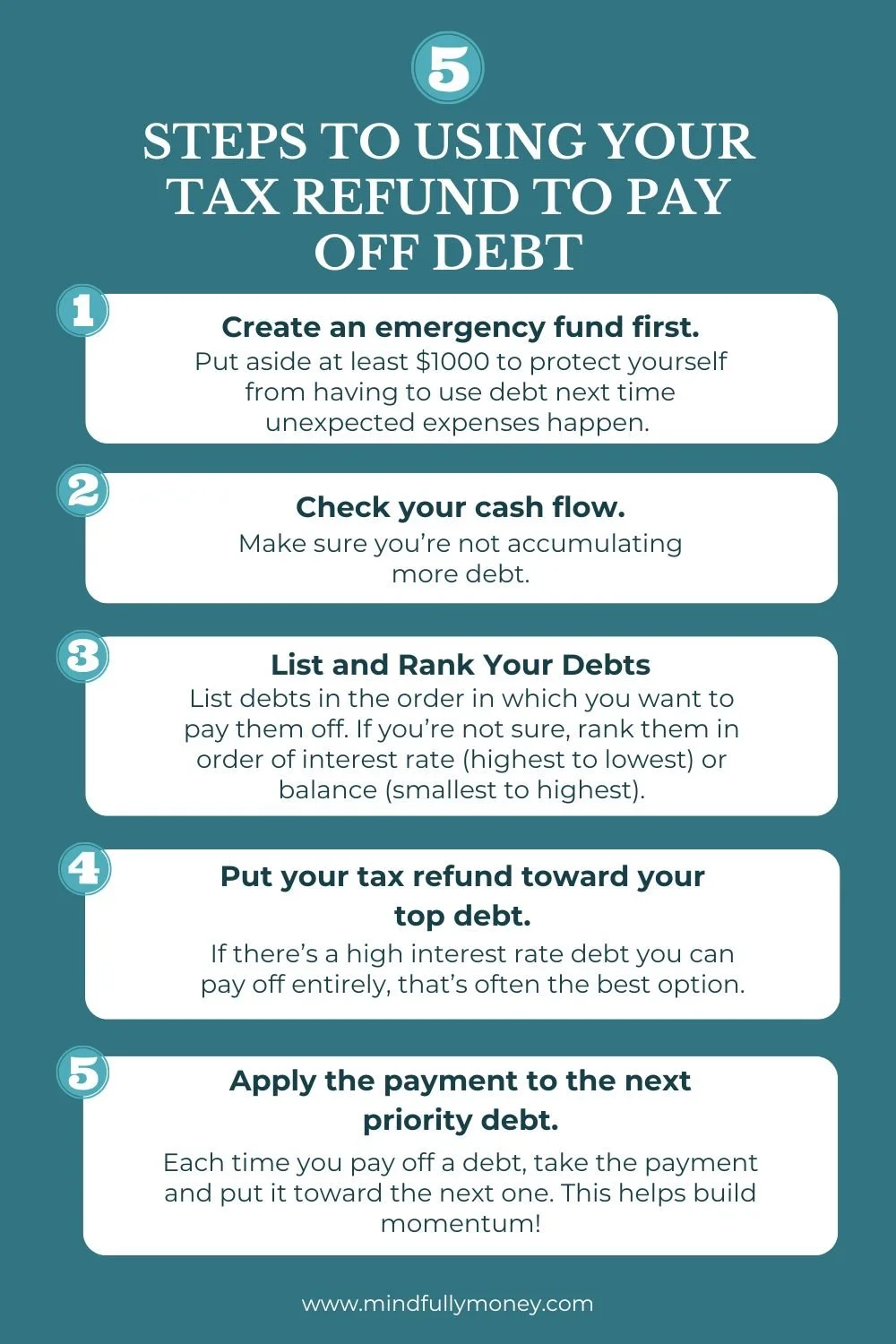
If you're trying to figure out what to do with your tax refund:
First: Make sure you have at least $1,000 in emergency savings and money set aside for upcoming expenses you know about
Second: Make sure you're not adding to your debt each month—you need a working cash flow plan first
Third: Pay off your highest interest rate debt that you can pay off completely (or put it all toward your highest rate if you can't pay anything off completely)
Fourth: Take the monthly payment you just freed up and add it to your payment on the next highest-interest debt
The goal is making strategic choices that set you up for long-term success—not just quick wins that feel good in the moment but don't move the needle on your overall debt.
Remember: Debt doesn't define you. If shame or stress around your debt is making it hard to take action, this post about overcoming debt shame might help.
Ready to tackle your debt strategically? Download my free guide Debt Payoff Made Easy for worksheets, decision frameworks, and motivation tips to help you choose which debt to pay off first—and stick with your plan.
Need Personalized Help Figuring Out Your Debt Payoff Strategy?
If you're looking at your debts and feeling overwhelmed about where to start, you're not alone. This is exactly the kind of situation I help women work through.
In a Financial Snapshot Session, I'll:
Analyze your complete financial picture (not just the debt)
Show you where your money is actually going
Create a personalized debt payoff strategy that fits your specific situation
Help you see patterns and priorities you might not see on your own
Give you a clear action plan you can actually implement
The investment is $397 for a 2-hour session where you get complete clarity on your finances and a customized plan to move forward.
Or, if you want ongoing support and accountability as you work through your debt payoff plan, my 8-Week Money Clarity & Confidence Program might be a better fit. We work together weekly to implement your system, troubleshoot challenges, and build the confidence to manage your money on your own.
Schedule a free 20-minute consultation and we'll talk about your situation and figure out which option is right for you.
Annie Hanson is an Accredited Financial Counselor® (AFC) and the owner of Mindfully Money Financial Coaching. She’ll talk about money with anyone who’s interested, but is most passionate about helping women feel confident and in control of their finances—without shame, judgment, or unrealistic expectations.
